No Harm Intended: The Trump administration has gutted the Endangered Species Act’s core protections. The groups defending one Nevada watershed are reeling.
On the night of April 30, 2016, three young men who had spent the evening drinking rum and shooting rabbits in the Nevada desert crashed a customized Yamaha Rhino—an off-road vehicle that looks something like a high-powered golf cart—into the chain-link fence surrounding Devils Hole, a water-filled cavern on a detached parcel of Death Valley National Park, about 90 miles northwest of Las Vegas. Trenton Sargent, 27 at the time, hopped out of the vehicle and blasted the surveillance camera mounted on the fence with a shotgun: blam! The commotion should have triggered a motion sensor, which should have triggered an alarm, but it didn’t. A barn owl roosting nearby kept setting off the security system, and rather than disturb the bird, National Park Service staff disabled it, according to a 2019 High Country News account of the break-in.
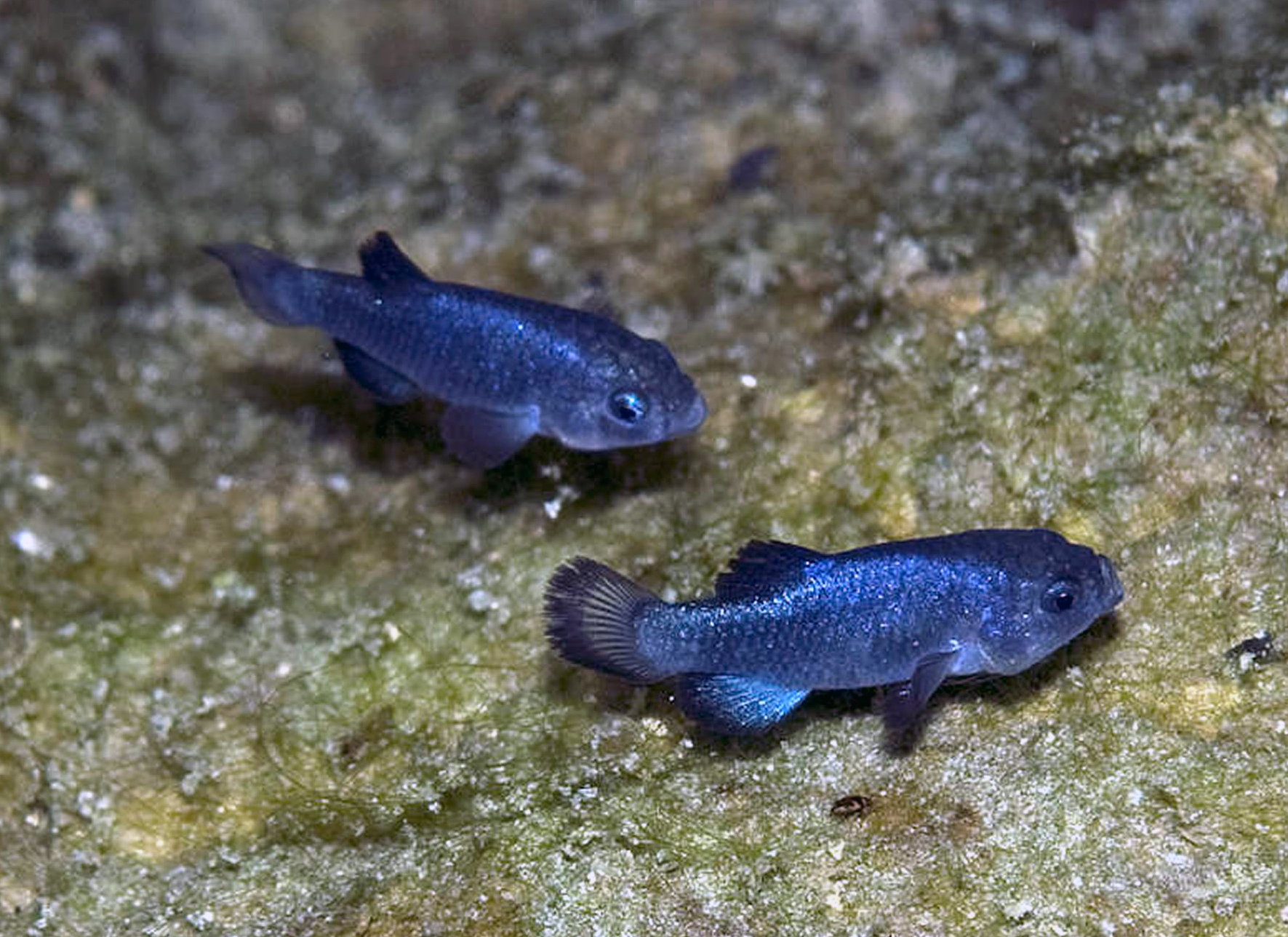
Sargent and his buddies hopped the fence and made their way down into Devils Hole, toward the habitat that fencing was meant to protect. Sargent took off his clothes and plunged into the warm, hot-tub-like water, onto a small, shallowly submerged limestone shelf where the Devils Hole pupfish—an inch-long, iridescent blue fish that exists nowhere else on Earth—feeds and spawns. It was late April, peak breeding season. That spring, researchers had counted 115 fish
“I was showing off for my friends,” Sargent later explained to a Nye County detective. He just wanted to see how deep Devils Hole was. He didn’t mean to kill a Devils Hole pupfish, one of the rarest fish on Earth. But he did.
Two days later, biologists found one of the little blue fishes floating dead on the surface of Devils Hole.
Sargent pleaded guilty to violating the Endangered Species Act (ESA), destroying federal property, and possessing a firearm as a felon (he’d previously been convicted on another offense). The judge sentenced him to a year and a day in federal prison, ordered him to pay nearly $14,000 in restitution, and barred him from visiting America’s public lands for the rest of his life. Nine months of that sentence were specifically for violating the ESA.
Were the same thing to happen today, the outcome would be different. Were Trenton Sargent to do what he did that night in April 2016 tonight, in October 2026, he wouldn’t be violating the ESA—as the Trump administration now interprets it—at all.
* * *
Last month, on September 14, Brian Nesvik, the director of the US Fish and Wildlife Service, signed an internal memo instructing agency staff on how to interpret the Endangered Species Act’s prohibition on “taking” a protected animal. Under the memo, which took effect immediately, killing an endangered animal is no longer considered an illegal “take” unless the act was “intentionally directed at a particular animal or animals.” The memo offers examples. “Felling a tree is not a take of the bats roosting in it unless the tree is felled for the purpose of killing or capturing them,” it reads. An ocean vessel that inadvertently strikes and kills a whale has not taken it, “because the vessel’s course was not set against the whale.” A drunken twenty-something who shoots his way into Devils Hole and accidentally steps on a Devils Hole pupfish hasn’t taken it, because, well, he didn’t mean to. That seems to be what the memo is implying, doesn’t it?
“That’s right,” says Noah Greenwald, endangered species director at the Center for Biological Diversity. “His [Sargent’s] intention was not to kill a pupfish. So, yeah, it wouldn’t count as taking.” Were Sargent to act today, Greenwald figures he’d still probably be charged with destroying federal property and possessing a firearm as a felon, but he almost certainly wouldn’t be charged for violating the ESA, so long as he didn’t intend to kill that pupfish.
It’s a strange hypothetical, but these are strange times. What’s left of the ESA’s prohibition on “taking” an endangered animal, Greenwald says, is the deliberate act of killing: “Stabbing an animal, pointing a gun at it, shooting it.” Killing an endangered animal inadvertently is no longer treated as a violation at all.
The Nesvik memo is just the Trump administration’s latest bit of wordplay related to the ESA. On July 10, the Interior and Commerce Departments announced a final rule rescinding the ESA’s regulatory definition of the word “harm,” which for half a century had included habitat destruction that kills or injures a listed species. The agencies didn’t write in a narrower definition of the term, or remove the word from the act itself. They simply deleted the old definition and left the word undefined. The practical effect is that destroying an endangered species’ habitat—whether by logging, mining, pumping, drilling, real estate development, or some other means—is no longer prohibited as “take,” either.
Interior Secretary Doug Burgum framed the change as a correction. “For years, federal agencies abused the E.S.A. to obstruct lawful land use and burden American families and businesses,” he said in a statement announcing the rule. “That approach turned routine activity into a regulatory trap, drove up costs that impacted people’s lives, and expanded federal authority beyond what Congress intended.”
The rule took effect on September 14, the same day Nesvik signed his memo.
Greenwald calls the changes “a radical departure from the last 50 years.”
“They’re basically cutting the heart out of the ESA,” Greenwald says of the current administration. “Basically, if this stands, there will not be an Endangered Species Act.”
* * *
To understand what these changes mean for wildlife, consider the Amargosa Basin. The Devils Hole pupfish is just one of the region’s rare and imperiled creatures.
Straddling the border of southeastern California and southwestern Nevada, the Amargosa Basin is a 3,100-square-mile expanse of salt flats, alkaline seeps, mesquite bosques, and creosote scrublands. It is home to more than 100 endemic species—species found nowhere else on Earth—more than a dozen of them listed as threatened or endangered under the ESA. “The Amargosa—which includes Death Valley—is the hottest, driest place on Earth,” says Patrick Donnelly, Great Basin director at the Center for Biological Diversity and a longtime resident of the Amargosa. “It’s full of serrated mountains. But the real action is in the valley bottom, because that’s where the water is.”
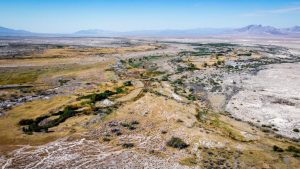
The Amargosa River runs mostly underground through one of the hottest, driest places on Earth, surfacing in a discontinuous chain of springs and wetlands. Photo courtesy of the Amargosa Conservancy
The Amargosa River runs through the valley bottom, the only free-flowing river in the Death Valley region of the Mojave Desert—though it spends most of its course underground. Where the river reaches the surface, it creates oases—discontinuous chains of springs and wetlands, each providing habitat to its own suite of unique organisms: pupfish, plants, snails, tiny aquatic invertebrates. For this reason, the Amargosa is sometimes referred to as the “Galapagos of the Mojave.”
“It’s like the Galapagos, but in reverse,” says Mason Voehl, who moved to the Amargosa in 2020 and until last month served as executive director of the Amargosa Conservancy, a local environmental nonprofit and A2 member. “In the Galapagos, you have islands of land surrounded by an ocean of water.” In the Amargosa, you have islands of water surrounded by an ocean of desert.
Devils Hole is one of those islands; the Devils Hole pupfish is its unique inhabitant. The fish has lived there—on a single, shallowly submerged limestone shelf about the size of a small bedroom—and nowhere else, since the last ice age. It was among the first class of species to be protected under the Endangered Species Preservation Act of 1966. That protection carried over when Congress passed the modern Endangered Species Act in 1973.
The Devils Hole pupfish is among the Amargosa’s most iconic inhabitants. It may also be among the most fortunate, in light of the Trump administration’s recent reinterpretation of the ESA. An intruder could trample and kill the fish, and he wouldn’t be “taking” it, so long as he didn’t mean to trample and kill it. A mine or a farm or a data center could drain Devils Hole of its water, eradicating the fish’s habitat, and it wouldn’t be “harming” it. What protection the fish has left has little to do with the ESA; it has to do with water rights.
In 1968, a ranching family called the Cappaerts started pumping groundwater on their 12,000-acre spread to irrigate their fields of alfalfa, wheat, and barley. A few miles away, the water level in Devils Hole started to drop. The Devils Hole pupfish was running out of habitat—and fast. The federal government sued, and in 1976 the Supreme Court ruled that pumping needed to be curtailed to keep the fish’s habitat submerged.
“That case mandates that the Nevada State Engineer manage water in this very large hydrographic basin for the purposes of maintaining viable habitat for a single species,” Voehl says. “That’s radical. I cannot imagine our Supreme Court doing anything like it in this era.”
The Devils Hole pupfish has its own water rights, and it has the Cappaerts and the U.S. Supreme Court to thank for them.
Its neighbors aren’t so lucky.
Surrounding Devils Hole are the springs and marshes of the Ash Meadows National Wildlife Refuge, which support at least two dozen species of plants and animals found nowhere else on the planet. Among them are the Ash Meadows Amargosa pupfish, a relative of the Devils Hole pupfish; the Ash Meadows speckled dace, a minnow that lives in the refuge’s fast-flowing springs, feeding on algae and aquatic insects; and the Amargosa niterwort, a salt-flat wildflower that blooms bright pink in 120-degree heat. All of these species are listed as endangered under the Endangered Species Act. None of these species has a Supreme Court case of its own.
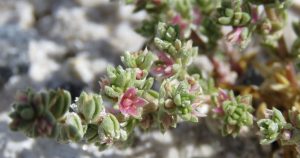
The Amargosa niterwort (Nitrophila mohavensis). Photo courtesy of USFWS
In April 2023, a Canadian prospecting company called Rover Critical Minerals proposed drilling 30 exploratory boreholes just north of the refuge, some within 2,000 feet of Fairbanks Spring, which is designated critical habitat for both the Ash Meadows Amargosa pupfish and the Ash Meadows speckled dace. The Amargosa Conservancy commissioned a hydrological analysis. The danger, Voehl explains, is that the region’s hydrology is “one big pressure system.” The springs of Ash Meadows flow where groundwater finds the weakest link in the crust. Puncture that crust, and you risk rerouting the water, draining the springs, and killing the species that live in them.
The Amargosa Conservancy and the Center for Biological Diversity sued, and fought the project off. Were the same project proposed today, Voehl would expect a different outcome. “I don’t think we would have been successful now with that litigation,” he says. “The lawsuit had teeth because of the ESA.” Now, “unless the mining company was literally going to wade into the spring and actively and intentionally try to kill pupfish in the spring, they wouldn’t be protected, because harm no longer means harming habitat.”
“We’re reeling from this in the Amargosa,” Voehl says of the Trump administration’s recent changes to the ESA. “They’ve effectively ripped the fangs out of the most important conservation tool we have. I fear it’s only a matter of time before—whether it’s in the Amargosa or somewhere else—there is going to be an extinction-level event resulting from some project like this that previously would not have been permitted. It’s extremely, extremely unfortunate.”
* * *
Now, consider the rest of the nation. The Devils Hole pupfish and the Ash Meadows Amargosa pupfish and the Ash Meadows speckled dace are just a handful of the nearly 1,700 species listed as threatened or endangered in the United States. “Almost anywhere you look in the country, there are species that need our concern and care,” Greenwald says. “These changes will undo their protections and in most cases make it so they just don’t get any consideration whatsoever.”
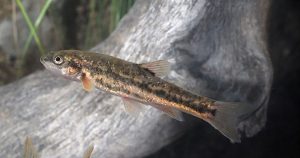
The Ash Meadows speckled dace (Rhinichthys osculus nevadensis). Photo courtesy of USFWS
To date, at least seven lawsuits have been filed challenging the Trump administration’s rollback of the ESA, two of them by a coalition of 21 state attorneys general. On October 1, a coalition represented by Earthjustice amended its case to include the Nesvik memo, which limits illegal “take” to the intentional killing of a protected animal. The Center for Biological Diversity is part of that coalition. Greenwald expects the litigation to play out over the next year or two—the administration, he suspects, would like to see it reach the Supreme Court—and is hopeful the harm rescission and the take memo will eventually be reversed. “I think the law itself—which they haven’t changed, they’ve just changed the rules and definitions—is on our side,” Greenwald says. It’s “what’s lost in the short term” that worries him.
“Scientists from around the world are warning that we’re in an extinction crisis,” Greenwald says. “We’re losing species at a greatly accelerated rate, and this threatens the quality of life our children and grandchildren can expect—especially in combination with climate change, these twin crises that are very much related. Now is the time to be addressing these problems. It’s just so unfortunate that we have this administration that’s going in the exact wrong direction.”

