
Suffocating heat can be deadly for workers. Louisiana Grassroots United is working to fix that
A couple of summers ago, Christopher Williams was cycling in New Orleans when he had to pull over and get medical help because of the suffocating heat.
He found himself suddenly feeling unwell and dehydrated. “I had a mini heatstroke and had to seek help at one of the urgent care facilities,” says Williams, A2’s community organizing manager.
Louisiana summers have always been notoriously hot and humid – but extreme heatwaves did not used to last as long. “Because of the fact that we had such high humidity, there would be afternoon rainstorms,” he says. “There would be a period where things would cool down, and then it would heat back up again.”
Recent years have seen the heat become increasingly punishing. “The last two or three summers that we’ve had here, we’ve been getting less precipitation in the summer and more dry heat. And that dry heat has caused the temperatures to go above 100 degrees,” Williams adds.
“We are in the era of climate change.”
The rising risk of heat-related deaths
Heat can have devastating impacts on the body, especially for elderly people, unhoused people, young children, and people with cardiovascular disease and some disabilities. When the body is unable to cool itself, heat-related illness, or hyperthermia, occurs, resulting in heat exhaustion or life-threatening heat stroke.
Outdoor workers, including those in agriculture, construction, and landscaping, are also highly vulnerable to high temperatures – making strong labor protections vital. In 2024, the Bureau of Labor Statistics recorded 48 fatal work injuries caused by exposure to environmental heat. This is believed to be a significant undercount, as heat-related deaths are often only logged under the immediate cause of death, like cardiac arrest.
According to a study in 2022, heat is responsible for as many as 2,000 worker deaths each year in the US and at least 170,000 work-related injuries. Yet Americans are still waiting for a federal regulation explicitly protecting workers from deadly heat.
Louisiana’s heat-related fatalities and hospitalizations have been on the rise in recent years: in 2024, the state’s health department tracked 51 heat-related deaths and 4,463 emergency department visits for heat-related illness. This followed a record 88 heat-related fatalities in 2023, when there were 6,142 emergency department visits for heat-related illness.
In 2010, 17 heat-related deaths were recorded.
Winning protections for New Orleans city workers
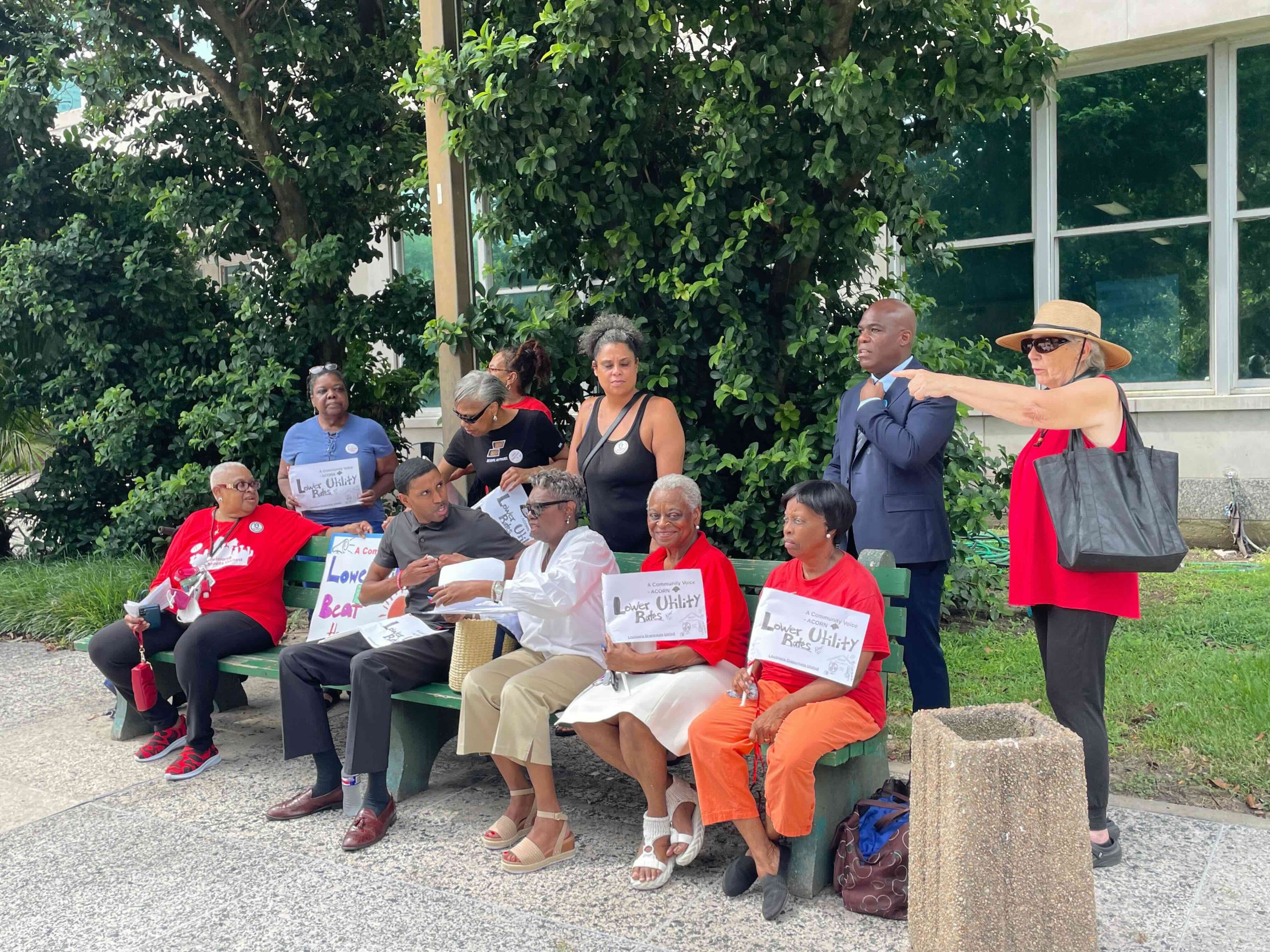
Against this backdrop of intensifying heat – and a lack of specific standards enshrined on the federal level or by the state of Louisiana – workers employed or contracted by the city of New Orleans have benefited from enhanced protections since last September, when it passed an ordinance on heat breaks. The ordinance followed a campaign spearheaded by A Community Voice (an A2 member) with the support of Louisiana Grassroots United (LGU), A2’s state organizing committee.
New Orleans’ ordinance requires employers to provide city workers and contractors with a paid 10-minute rest break every two hours at temperatures exceeding 80F, and a paid 15-minute break every two hours beyond 90F. Breaks must be taken in an area protected from direct sun, and the measure applies to both outdoor workers and those working in spaces without air conditioning.
“You would think, especially given extreme heat…that this would be standard operating procedure. But it’s not,” Councilmember Oliver Thomas, who sponsored the resolution, said at the council meeting in September. The measure passed unanimously.
Members of Louisiana Grassroots United meet with council member Oliver Thomas. Photo courtesy of LGU.
Formed in February 2025, LGU, a coalition of more than a dozen groups, considered the ordinance an effective way to rapidly protect workers. “We wanted to come out of the gate with a win. We looked at what we could realistically pass immediately on the city level,” Williams explains. “We had the support of workers, environmental groups, and the local transit authority union.”
At present, the federal Occupational Safety and Health Administration (OSHA) does not have a heat-specific standard for working during high temperatures. Instead, heat falls under the General Duty Clause, which requires employers to provide a workplace free from “recognized hazards”. But without a specific temperature threshold, enforcement is not uniform.
The Biden administration proposed a federal heat-specific workplace safety standard in 2024, but the proposal appears to have stalled under the Trump administration. Measures outlined in the proposal included the provision of water, shade, and cooling above 80°F, as well as regular paid rest breaks and worker monitoring above 90°F.
Without a clear federal standard on working in extreme temperatures, protections for workers vary wildly across the United States. California, Washington, and Oregon have the strongest state heat labor laws, requiring employers to provide workers with measures including water, shade and cooling areas, rest breaks, training, and acclimatization for outdoor workers once temperature thresholds are reached.
In stark contrast, Florida, where private sector workers are only covered by federal OSHA’s General Duty Clause, passed legislation in 2024 preventing local governments from creating their own heat safety rules.
Back in Louisiana, construction workers, sewage and water board employees, and the vast numbers of New Orleanians employed by their city’s parks and recreation department are among those who benefit from the new ordinance.
Beth Butler, executive director at A Community Voice, says that since the ordinance’s passage, her organization’s members have continued monitoring implementation to ensure employers are providing the required heat breaks. “When the heat index hits 80F, it’s very obvious here and our members are very concerned,” she says.
She adds that the initiative was part of the ACORN International “Beat the Heat” global campaign, which advances protections for workers facing dangerous heat conditions around the world.
Butler says that the ordinance was supporting thousands of New Orleans workers and contractors. “Most are working poor; they are neighbors, friends and family of our members and our constituency,” she says. She adds that it comes against the backdrop of “right-wing attacks” on community efforts like distributing bottled water to voters and punitive measures against unhoused people. Along with the climate crisis, this context demands “community-led direct action on behalf of the workers,” she says.
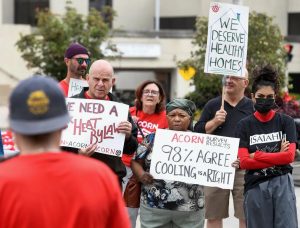
Members of ACORN International calling for heat protections during their global “Beat the Heat” campaign. Photo courtesy of ACORN International.
Guidance for the private sector
While New Orleans’ ordinance does not cover those employed by the private sector, its organizers hope it will have a ripple effect. “Hopefully, this ordinance is a guideline for all employers in the city – that’s what it was meant for,” Williams says, adding that this point was also emphasized by councilmember Thomas during a press conference.
Williams says there is some evidence that employers in the private sector are voluntarily taking up the mantle to strengthen protections in response. “Some employers with outdoor workers have decided to give their workers some level of heat breaks,” he says, though he adds that it is “not exactly what we’ve done on a city level.”
Rest breaks are particularly important for outdoor workers, like those working cutting lawns and washing windows, but also for the thousands of people employed in New Orleans’ restaurant sector. “We have a large number of restaurants – over 1,200 – in the city,” says Williams. “That’s a lot of restaurant workers who have to work inside hot kitchens year-round, and it’s even worse during the summer.”
State legislation would be needed to impose similar requirements on the private sector. Although New Orleans’ home rule charter grants the city the authority to manage its own municipal affairs, there are limitations on its powers. Williams says pushing for legislation on the state level “could be something we look at,” but he doubts it would pass at present.
Heat islands and environmental inequalities
Looking forward, LGU is also hoping to help the city’s residents mitigate heat using the city’s green spaces. “We know some young people don’t have access to pools because they are not in every area of the city,” Williams notes. To combat this, the alliance is pushing for the city to install splash pads in parks as “an affordable way to get children out of the heat.”
The city’s residents do not share the burden of soaring temperatures equally: the heat island effect, where some urban areas are much hotter than others, often mirrors the city’s socioeconomic and racial divides. “It’s a lot cooler near City Park. That property is mostly owned by more wealthy and more white New Orleans residents. It’s by the lakefront, which is also cooler – and lined with multi-million dollar houses. We used to have affordable housing along the river, another cooler area, but unfortunately that has changed, especially post Katrina and post the pandemic,” he reflects.
“We have more heat zones in the lower-aligning areas of the city,” Williams says, explaining that New Orleans is built over a basin. “And much of the poorer area of the city is in the middle of the bowl.”

