
The Dry Hurricane: The first hurricane to test FEMA under Trump’s cuts hit Florida’s Panhandle in October. Neighbors and nonprofits — not the federal government — led the early recovery.
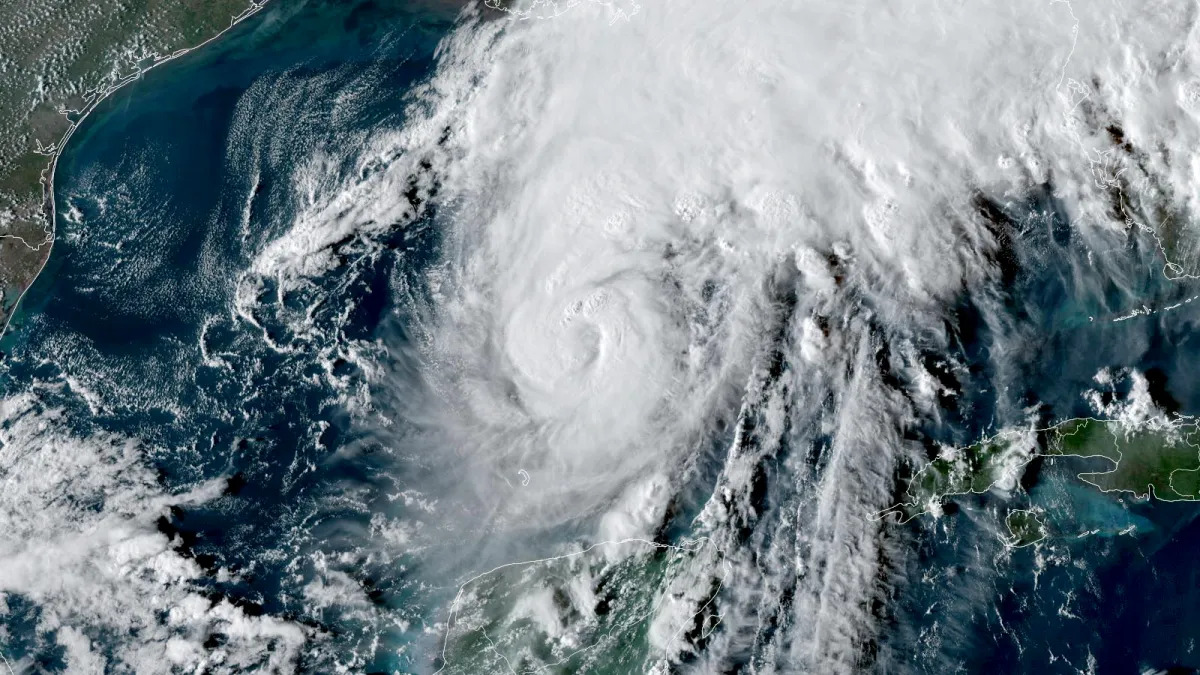
The night Hurricane Isaias came for the Florida Panhandle, Gloria Horning knew what she had to do. She sandbagged her house in Pensacola, Florida’s Tanyard neighborhood — one of the lowest, most flood-prone corners of the city. She wrapped her belongings in plastic and stacked what she could on the countertops. She loaded what matters most into her truck and drove to a friend’s place on higher ground, out of the floodplain.
When the storm hit, trees started falling — two of them onto Horning’s friend’s house. Across the region, the oaks that came down were enormous. “I’m not talking little trees,” Horning says. “I’m talking four-foot-diameter, six-foot-diameter trees coming down. It was the craziest thing I’ve ever seen in my life.”
Horning and her friends rode out the storm and emerged uninjured. The next morning, Horning drove home to find that a tree had fallen through her roof, too. Her air conditioner — raised on a five-foot stand — hung half off its perch. What she didn’t find, oddly, was water.
“It was the weirdest hurricane I’ve ever been in,” Horning says, and she’s been in a number of them. She grew up with storms in southern Louisiana. She’s lived in the Tanyard since 2016, where she endured Hurricane Sally in 2020. During that storm, her home took on four feet of water. The flood rose to her windowsills. The National Guard had to pull her and her dog, Roux, to safety. Isaias was different. “It wasn’t a rain event at all,” Horning says of the storm. “It was a dry hurricane.”
Isaias made landfall near Destin, Florida, late on October 9, as a Category 2 hurricane. It behaved like few storms the coast had seen before. As it came ashore, it shed much of its tropical character. It drew in dry air, grew cold. A narrow band of its most intense winds broke out on the western side of it, over Florida’s Escambia and Santa Rosa counties, which in the Northern Hemisphere is usually referred to as the “clean side” of a hurricane. Rain fell farther north; parts of inland Alabama received nearly 13 inches. But the storm brought little rain to Pensacola. Horning’s home saw about two inches of rainfall, she says.
What Isaias brought to the Pensacola area wasn’t water, but wind. Gusts topped 100 miles per hour. Trees came crashing down across Escambia and Santa Rosa counties, falling on people’s homes, blocking roads, and toppling power lines. (An acquaintance of Horning’s ended up in a Mobile burn unit after a downed line set his house on fire.) The gales ripped roofs off buildings. Windows were shattered by flying debris. In Santa Rosa County alone, more than 2,000 buildings were damaged, roughly 80 destroyed. Insurers put the statewide bill, as of mid-October, at around $582 million. At least eight people across Florida and Alabama lost their lives during the storm.
Meteorologists are still debating whether a rare feature called a “sting jet” contributed to the storm’s violent winds. Climate change had a hand in its strength, too: the nonprofit Climate Central found that abnormally warm Gulf waters — made far more likely by human-caused warming — helped Isaias rapidly intensify, adding an estimated seven miles per hour to its peak winds.
In Pensacola, the damage was widespread. “There’s not one street that wasn’t hit,” Horning says.
But the storm hit those with the fewest resources the hardest. Those with money can pay someone to haul the trees off their roofs, Horning points out. Those with insurance can file claims. “But the people without insurance?” Horning says. “They’re just flat out of luck.” Many of the hardest-hit homes were trailers, some wind-shredded beyond repair, rendered unlivable.
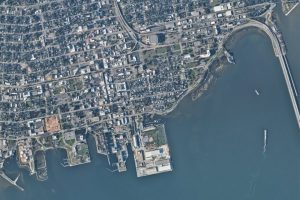
An aerial view of Pensacola, Florida, on October 11, 2026. Photo courtesy of NOAA
Help from the federal government has been slow to arrive — which isn’t necessarily surprising, in light of the Trump administration’s recent cuts to and restructuring of the Federal Emergency Management Agency (FEMA). FEMA shed more than 4,300 employees in 2025, about 17 percent of its workforce, according to a Government Accountability Office report; the departures included hundreds of on-call disaster responders. (A plan to cut the agency’s ranks in half was ruled unlawful by a federal judge in September.) Nearly 60 senior executives left the agency between January 2025 and January 2026, against a prior norm of roughly 13 per year. One of them was Robert Samaan, the administrator of FEMA Region 4, an office responsible for eight states, including Florida and Alabama. “My biggest concerns are always the loss of institutional knowledge,” Deanne Criswell, who led FEMA under President Joe Biden, told the Guardian last month. “You lose that knowledge. You lose the people who had been through these big disasters in the past.”
In January 2025, the week he took office for his second term, President Donald Trump appointed a task force to evaluate FEMA for reforms. In May of this year, that task force — the FEMA Review Council — issued its long-awaited report. The report recommended reserving federal disaster aid for “truly significant events,” and shifting the financial burden of both disaster recovery and hazard mitigation onto states, localities, and individuals. Joanne Pérodin of the CLEO Institute, a Miami-based nonprofit and A2 member dedicated to climate crisis education, warned then that the gap left by FEMA would most affect disadvantaged communities with the fewest resources for dealing with disasters.
As the first hurricane to make landfall in the United States in 2026, Isaias was the first major test of FEMA’s ability — and willingness — to respond to natural disasters after the Trump administration’s reforms to the agency.
“The difference is night and day,” Horning says. “After Sally, FEMA was on the ground within a day. Blue tarps were going up everywhere. Now you’ve got to pay someone to put a tarp on your house.”
After Hurricane Sally in 2020, President Trump approved Florida’s major disaster declaration — which mobilizes FEMA personnel and unlocks federal aid for recovery — five days after the state requested it. (Governor Ron DeSantis had asked for that declaration to be expedited.) This time, Florida submitted its request on October 15, and waited.
In Pensacola, in the aftermath of Hurricane Isaias, the gap left by FEMA was filled largely by local volunteer groups, Horning says. Groups like the Cajun Navy, a grassroots network of volunteer first responders that has been performing disaster relief, supply distribution, and chainsaw-clearing operations in the region for weeks. Groups like the Jack Brewer Foundation, which has cut trees off homes, cleared roads, and handed out food and supplies across Pensacola, Gulf Breeze, and Milton, free of charge. Groups like Higher Ground Pensacola, the environmental justice nonprofit and A2 member that Horning has been running out of her home in the Tanyard since 2018.
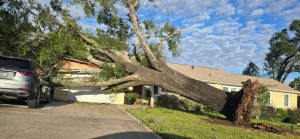
A downed tree in Escambia County on October 10, 2026, following Hurricane Isaias. Photo by Molly Barrows
“I am Higher Ground Pensacola,” Horning says with a laugh. She is the organization’s sole employee. She is 70 years old. And even she has been out and about in the Tanyard with a chainsaw, clearing trees. “That’s what we need right now,” Horning says, “neighbors helping neighbors. The nonprofits have really just done an incredible job.”
About 25 miles northeast, across Escambia Bay in Santa Rosa County, the story has been much the same in Milton, where more than 50 homes were rendered uninhabitable by the storm and nearly 80 people have been displaced. “The Cajun Navy was really good,” says David Samples, a leader of Save Blackwater River, a Milton environmental group allied with Milton’s Concerned Citizens, an A2 member. His neighbors have been helpful, too. “People helping people,” Samples says. “That’s always a good thing.”
Meanwhile, FEMA took to social media. “Recovery from Hurricane Isaias is being led by state and local officials and responders,” the agency wrote in a Facebook post on October 13, four days after Isaias made landfall. “In Santa Rosa County, Team Rubicon crews cleared large fallen trees so utility crews from Oklahoma could safely reach damaged lines, replace power poles and restore service.”
“This is recovery in action,” the post continued, “states helping other states and partners working side by side to help communities move forward.”
On October 20, more than a week after the storm hit, FEMA Administrator Cameron Hamilton spoke at a conference of state emergency managers in Little Rock, Arkansas. “Every state must have the appropriate financial reserves to ensure that recovery efforts can start immediately and not necessarily be held up simply because of the federal [disaster] declaration process,” Hamilton said, according to POLITICO. “A future that I hope we would shoot for is one where we wouldn’t require as many disaster [declarations] because the capability of states is so high and so substantial,” he added.
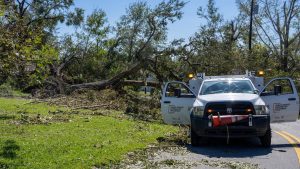
A utility crew from Oklahoma works to repair damaged lines in Santa Rosa County after Hurricane Isaias. Photo courtesy of FEMA
Trump eventually approved a major disaster declaration for Florida on October 27, more than two weeks after Isaias made landfall. The approval came about a week before Election Day.
“It took a while,” says Pam Mitchell, who co-founded Milton’s Concerned Citizens in 2018. “The city was really sweating it.”
The city of Milton is home to fewer than 11,000 residents and is less than six square miles in size. In the wake of Isaias, the city is estimating that debris removal alone will cost upwards of $24 million. Without federal disaster aid from FEMA, Mitchell says, “the cost of debris removal alone could completely drive a municipality or a county government into bankruptcy.”
In 2004, Florida was hit by four hurricanes in one season. “A season like that could bankrupt a whole state if it wasn’t for FEMA,” Mitchell adds. “We very much need those resources.”

