
The Bird Counters: On the last remnants of Missouri’s prairie, a six-person nonprofit is tracking the disappearance of North America’s fastest-vanishing birds—and what their loss reveals about the health of the land we depend on.
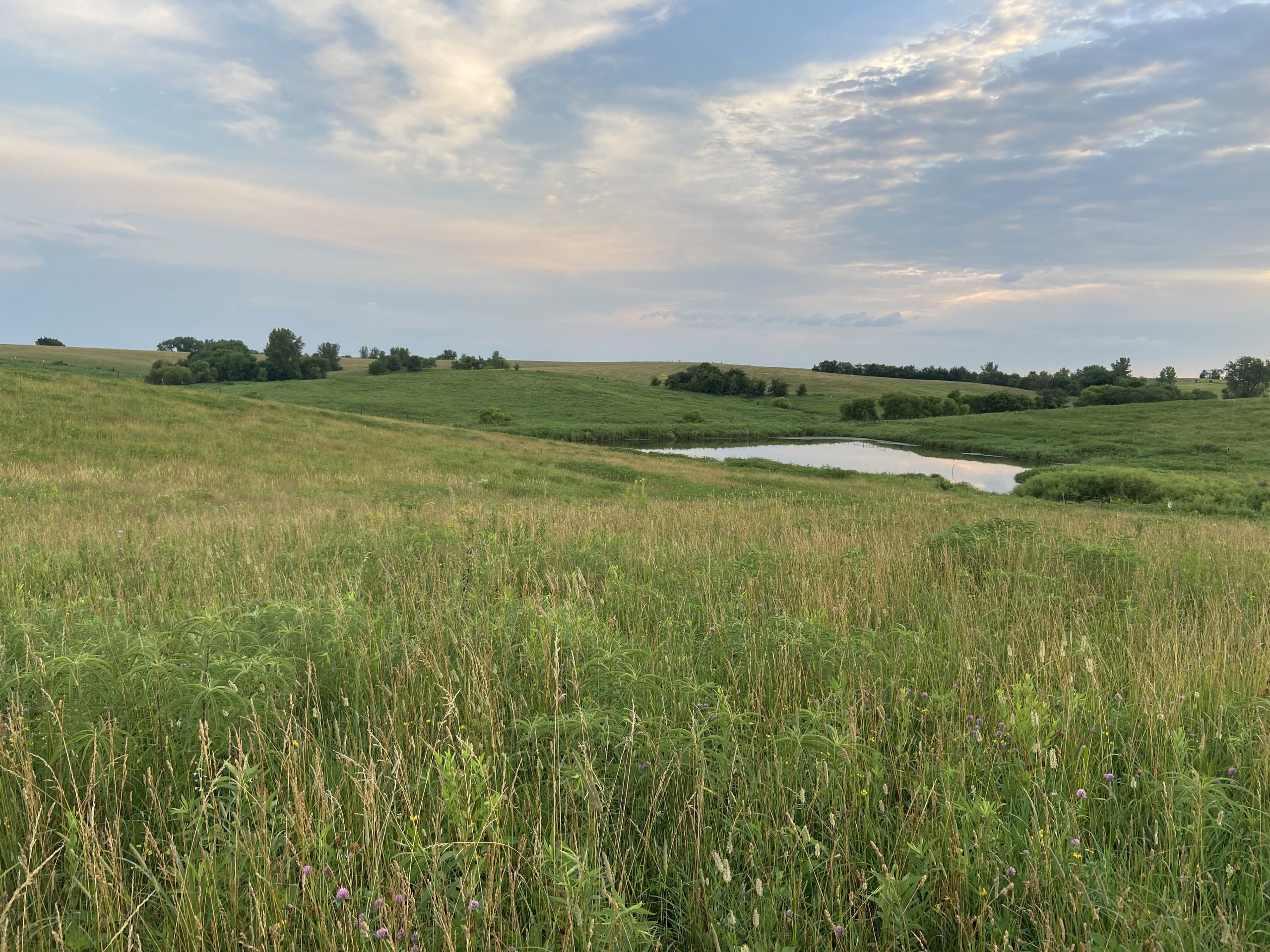
Before dawn, while most of Missouri is still asleep, Matt Longabaugh is already walking a prairie. He wakes around 4 a.m., drives to whatever grassland his crew is surveying that morning, and tries to be in position half an hour before sunrise. Fifteen minutes before the sun clears the horizon, he starts to walk, slowly, down a straight 400-meter line through the tall grass. He watches. He listens. He plots every bird he sees or hears on an iPad, tags its location, notes its species, estimates its age. By the end of a morning, he may have logged as many as 250 birds. By the end of a season, walking hundreds of miles across dozens of sites, he and his crew will have logged close to 30,000. “We cover some serious ground,” Longabaugh says.
As science coordinator at the Missouri River Bird Observatory (MRBO)—a small, Arrow Rock-based nonprofit and A2 member that has been counting the birds of Missouri’s grasslands for more than a decade—Longabaugh is something of a professional birder. He’s humble—bashful, even—when asked about his work. A “glorified, paid bird watcher,” is how he describes himself.
But he’s doing something extraordinary, morning after morning. He’s conducting something like a running census of some of North America’s most endangered ecosystems. He’s tracking the declines of some of North America’s most imperiled bird species. And he’s looking for a way to save them.
Where these birds vanish, they signal that something larger is coming apart—not just the habitat they need, but the web of grass, insects, water, and soil that makes the prairie possible.
* * *
Grasslands are easy to overlook, because they look like a whole lot of nothing. They are flat, empty, treeless—the sort of places you drive through on your way to someplace else. Flyover country.
But there’s more to these biomes than meets the eye. Grasslands and rangelands cover more than half of Earth’s terrestrial surface and support some 2 billion people, according to the United Nations Environment Programme. They produce 16 percent of the world’s food and hold as much as 30 percent of the carbon stored on land—most of it not in the grass itself, but in the dense, deep root systems that also anchor the soil and soak up rain before it can erode the ground or flood it. They provide habitat for pollinators and migratory birds, among other wildlife. Take a walk in a grassland, as Matt Longabaugh does each morning, and you will see that they are anything but empty; they teem with life.
Yet they tend to go unappreciated. Most of the world’s temperate grasslands have already been lost to industry and invasive species, farming and urban sprawl. The United States has lost nearly half of its grasslands—to industrial agriculture, primarily—and continues to lose another 2 million acres each year. Prairies have been particularly hard hit. Ryan Sensenig, a grassland ecologist at the University of Notre Dame, estimates that only 2 percent of America’s native tallgrass prairie remains intact.
These losses have been pronounced in Missouri. Before European settlement, tallgrass prairie blanketed roughly 15 million acres of the state—about a third of it. Today, according to the Missouri Department of Conservation (MDC), less than one percent of that original prairie remains. What’s left survives in scattered fragments, which the MDC has likened to postage stamps stuck here and there on a billboard.
“We in Missouri have less than one percent of the prairie acreage that we had at the time of settlement,” says Dana Ripper, who founded MRBO in 2010 with her husband, Ethan Duke—two field biologists who came to Missouri for temporary work and never left. Prairies, she says, are Missouri’s “most imperiled ecosystems.”
Likewise, the birds that depend on these ecosystems are Missouri’s most imperiled bird species.
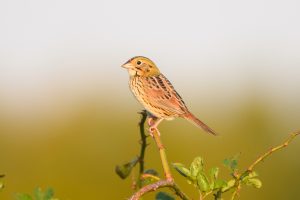
The Henslow’s sparrow, like most grassland birds, is in decline. It is designated a Bird of Conservation Concern by the U.S. Fish and Wildlife Service. Photo courtesy of Matt Longabaugh
Grassland birds are among the most threatened groups of birds in North America, in fact. And that’s saying something, because North American birds as a whole haven’t fared well over the last half-century or so. A landmark study published in Science in 2019 found that North America has lost nearly 3 billion breeding birds since 1970—700 million of which were grassland birds. Since 1970, grassland bird populations have fallen by 43 percent, a steeper drop than any other group, according to the 2025 State of the Birds report. Grassland birds, the report found, are now the fastest-declining group of birds in North America.
Matt Longabaugh sees what these trends have come to, firsthand, every morning. Drive through Missouri’s monoculture farm country, he says, and the birds don’t thin out; they vanish. “In a lot of these areas, they’re not declining, they’re just absent,” he says. “There’s not sufficient habitat. There’s not sufficient food. There’s no trees to hide in or grass to hide in.”
The prairie is gone, and the birds have gone with it.
Every morning, Matt Longabaugh takes a walk through one of Missouri’s last remnants of intact prairie, and counts survivors. Since 2012, MRBO’s field crews have surveyed grasslands across Missouri and, in some years, neighboring states. They survey around 85 sites in a typical year, from small, eight-acre patches to conservation areas of 6,000 acres or more. They count birds for two reasons: to keep a handle on how bird populations are faring, and to measure how different ways of managing the land affect the birds that live on it.
For a six-person outfit, the group is unusually high-tech. The data that Longabaugh and his field crew collect on their iPads each morning sync automatically into a mapping system that Duke—a data specialist—built to crunch the numbers in near-real time. “Previously,” Ripper says, “you’d collect all the data and then you’d spend two months entering it into Excel.” Now, the results—graphs, lists, maps showing exactly where each species turned up—are ready almost instantaneously, and land directly in the hands of the state agencies and private landowners MRBO works with. “Literally, it happens on a daily basis,” Ripper says.
“What makes this even more concerning,” she adds, “is that MRBO’s survey sites are the ‘best of the best’—public and private land managed for quality habitat and species diversity.” These aren’t farmlands we’re talking about here. These are the finest fragments of habitat Missouri’s grassland birds have left. And even there, the birds are slipping away.
MRBO’s findings are a microcosm of the bigger, continental picture. A study published last year in Science found that North American birds are now vanishing fastest from their historic strongholds, the places where they used to be most abundant—the sort of places that MRBO monitors. Another recent studyfinds bird losses speeding up in regions of high-intensity agriculture—regions like Missouri.
More concerning still is that no single culprit explains why this is happening. There are many, they vary from bird to bird, and nearly all of them lead back to us.
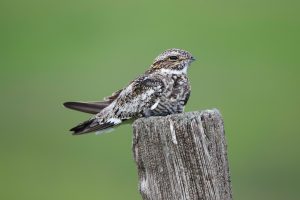
The common nighthawk nests on open ground and feeds primarily on insects. Photo courtesy of Matt Longabaugh
Some birds, Ripper says, need “intact prairie landscapes on the order of thousands of acres to maintain viable populations, and we just don’t have that anymore.” They’ve lost too much habitat, and the habitat that remains is too fragmented to sustain breeding populations. Some birds are hunted by free-ranging cats; outdoor cats, it has been estimated, kill between 1.3 and 4 billion birds each year in the U.S. alone. Some birds are threatened by pesticides, which not only poison birds but wipe out their insect food supplies. (“Folks don’t see nearly as many insects as they used to,” Longabaugh says. “The windshields on their cars are much cleaner than they were 30 years ago.”) Some birds are threatened by all of the above.
If you want to see where these trends lead, consider a bird Longabaugh has spent years looking for but has never once seen: the greater prairie-chicken.
The deep, resonant booming of the males—a sound that carries as far as a mile, made in the throat and amplified by the bright orange air sacs on their necks—was once a defining sound of the Midwestern prairie. In Missouri, the bird is now endangered. The state’s conservation department, Longabaugh says, lists fewer than 25 individuals left, clustered at two last-stand sites: one in the northwest corner of the state, one in the southwest.
Longabaugh has surveyed both of those sites, personally, for several years. “Even in these areas that were sort of the last quote-unquote strongholds,” he says, “they have declined to the point of extirpation. I have never seen a greater prairie-chicken at either of those sites.” Neither, he adds, has anyone else he’s talked to—not the agency biologists, not the local birders. Twenty-five, he suspects, may be an optimistic number.
* * *
Several factors are driving the declines of Missouri’s grassland birds, but the key driver, Ripper says, is high-intensity agriculture. Intensive farming is, after all, what destroyed most of Missouri’s grasslands in the first place. “Vast row-crop monocultures and toxic pesticides are decimating birds, butterflies, moths, and almost everything else,” she says. “High-intensity agriculture has emerged as the problem for prairie-obligate species.”
But agriculture might also be part of the solution.
Not long ago, some of MRBO’s staff visited a cattle ranch in southwest Missouri that is enrolled in the Audubon Conservation Ranching program—a certification, sometimes marketed as “bird-friendly beef,” that rewards ranchers who manage their lands for grassland birds. MRBO does the bird surveys that help verify these ranches are living up to the label. Nationally, the program now spans nearly 4.5 million acres across more than 150 farms and ranches in 15 states. The idea is that cattle, grazed the way bison once roamed, can keep a prairie—and its birds—alive.
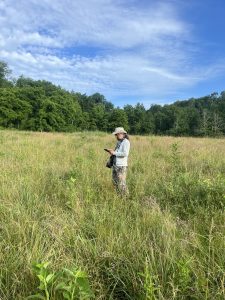
MRBO co-founder Ethan Duke counts birds in the field. Photo courtesy of Dana Ripper
The ranch MRBO visited—Round Rock Ranch—belongs to Dave Haubein, who, according to the National Audubon Society, was the first rancher in the country to earn an Audubon Bird-Friendly certification. Longabaugh kept a running list of bird species as he toured the property. The prairie looked healthy, Longabaugh says, and the animals looked healthier than any he’d ever seen. “And I think I saw something like 40 bird species,” he adds. “Just seeing that evidence that it is possible to live alongside birds—that filled me with hope.”
And that, in the end, is the case MRBO’s counting makes. The birds are a measure of everything beneath them—the grass, the insects, the water, the soil, the health of the landscape itself.
“Birds are the quintessential canary in the coal mine,” says Peter Marra, an ornithologist at Georgetown University. “They sit on top of food webs. And when birds decline, they signal that there’s this general decay, this general decline of the integrity of these habitats that even humans are a part of. That should be a huge alarm for people.”
“The canary in the coal mine is a good analogy,” Ripper agrees. But a better one, she suggests, might be “the meadowlark in the soybean field.”

