
The Last Line of Defense: As the Trump administration opens millions of acres of public land to logging, two aging conservationists are fighting back—and winning.
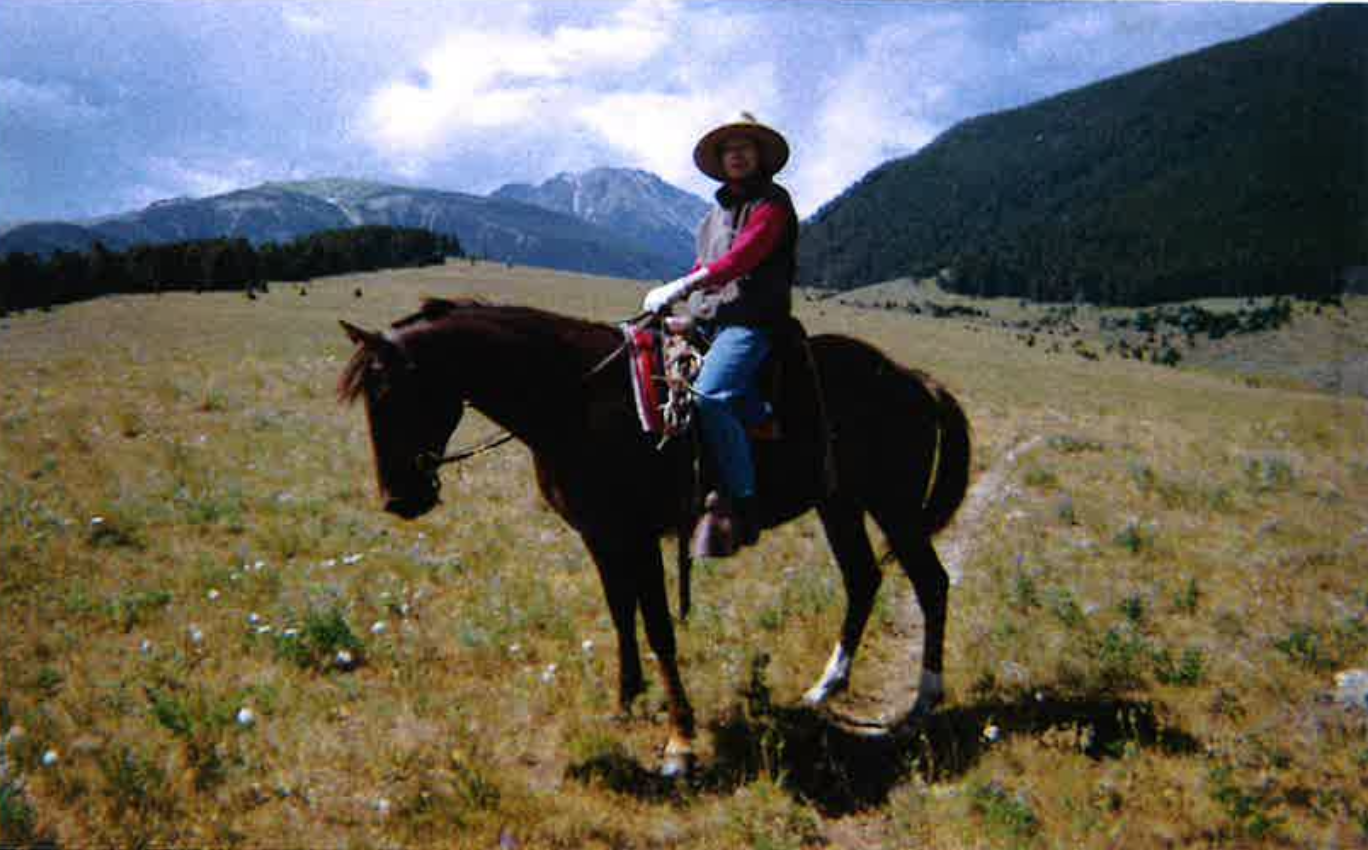
Every afternoon, Sara Johnson sits down at her desk in Three Forks, Montana, and goes to work. She works from home. The Bridger, Madison, and Tobacco Root mountains define the horizon outside her window. The Jefferson River meanders in braided streams through a corridor of hundred-year-old cottonwoods. Migratory birds chirp, squawk, and sing, drawn by the thousands of Russian olive trees that Sara and her ex-partner planted on their property years ago. “It’s peaceful,” she says.
What Sara does at that desk, three to four hours a day, seven days a week, is read logging proposals. She reads hundreds of them each year, issued by the U.S. Forest Service and the Bureau of Land Management (BLM) across national forests and public lands stretching from Montana and Idaho down into Utah and Nevada. She reads for problems. Threats to sage-grouse nesting territories, say, or to grizzly bear migration corridors, or mule deer habitat. When she finds problems, she writes comment letters explaining to the Forest Service and the BLM—and anyone else who cares to listen—how and why a given logging project would harm wildlife. Last year, she wrote about fifty such letters. Some years she writes more. If, despite her concerns, the project is approved, she lawyers up and sues.
Sara Johnson is in her eighties. She has no staff. She has no insurance. She pays herself what she can afford. She’s been doing this work, alone, out of her home, since 1992. She is, perhaps, the most effective defender of wildlife habitat on America’s public lands.
The only other person who even comes close is Michael Garrity, 65, executive director of the Alliance for the Wild Rockies (AWR) in Helena, about 60 miles north. Garrity is the organization’s sole employee. Sara Johnson is the sole employee of her own nonprofit, called the Native Ecosystems Council (NEC). Together, according to Garrity, the two organizations filed roughly 70 percent of all environmental lawsuits brought against the federal government last year. They filed most of these lawsuits jointly, as co-plaintiffs. They defeated nearly all of the logging projects they opposed, protecting more than 1.7 million acres of wildlife habitat through court victories and project withdrawals.
“We do pretty well,” Garrity says with a chuckle. “And we’re both one-person nonprofits. I’m the only staff member at the Alliance. Sara’s the only staff member at Native Ecosystems Council. And compare that to, you know, groups like the Wilderness Society or the Sierra Club. They have hundreds and hundreds of staff members, and their annual budgets are hundreds of millions of dollars. We operate on shoestring budgets, especially compared to these big groups.”
* * *
Sara Johnson didn’t set out to spend her life suing the federal government. She set out to work for it.
She grew up on a ranch in South Dakota in the late 1940s, got a PhD in wildlife biology from Montana State University in 1973, and went to work for the Forest Service on the Targhee National Forest, on the southwestern border of Yellowstone National Park, in 1974. She liked the work at first. She spent her first two summers in the field, studying grizzly bear-sheep conflicts, and “discovered so many problems that the study was terminated.”
What kind of problems?
“Grizzly bears killing sheep,” she says, matter-of-factly.
She transferred up to Montana’s Gallatin National Forest (which is now the Custer-Gallatin National Forest) a few years later, in 1980. She was, in her own words, a “tree hugger,” a “radical,” a “hardcore environmentalist.” As a wildlife biologist with the Forest Service, however, her primary duty was to coordinate wildlife habitat with logging projects. And therein lay her dilemma.
“They have a term for Forest Service biologists,” she says. “They call ’em combat biologists. And that fits because if you’re supporting wildlife, you’re going to see conflict. Logging is just devastating to all your wildlife.”
Things came to a head in 1988, when the Forest Service started planning a logging project in the Bridger Mountains. “The supervisor had all his staff there in a big meeting,” Sara recalls. “All his specialists were there. And the supervisor said that this big logging program would be good for mule deer. And I said, ‘Oh no, it won’t. It’ll be really hard on them.’ A couple weeks later, my job was eliminated.”
“That was politics back then,” she says, 38 years later. “It’s a lot worse now.”
She founded NEC in 1992, and she’s been suing her old employer ever since. “The Forest Service created me,” she says. “Working for the Forest Service, you know, it was quite an education in how devastating logging is.”
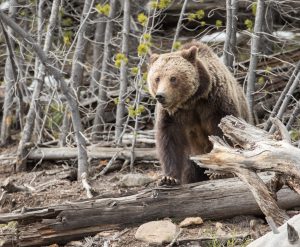
Montana’s Absaroka-Beartooth Wilderness, near Cooke City, provides vital grizzly bear habitat. Photo courtesy of Michael Garrity/AWR
Not long after she founded NEC, Sara got a call from a young man in Helena named Michael Garrity. An environmental economist by training, he was working for a Republican congressman from Utah who happened to be an ardent conservationist. They got to talking about a proposed logging project in Montana’s Helena National Forest.
“You know how you discover soul mates?” Sara Johnson says. “I told him that I’d like to shut the Helena logging program down. And he said, ‘So would I.’ And that’s when I knew we were on the same page.”
* * *
The two of them have been working closely ever since. For decades, they’ve worked like this: They get themselves onto the Forest Service’s mailing lists to track proposed logging projects. They read project proposals. They identify threats to wildlife. They write comment letters at every stage of the review process—scoping, draft proposal, final decision—because, as Johnson says, if you don’t comment, you have no standing to sue. When a project clears all three comment phases, they find a lawyer and file.
Of the 186 environmental lawsuits brought against the U.S. government to protect wildlife habitat last year, AWR filed 86 of them—about 46 percent of the total. NEC co-filed most of those, along with an additional 24 percent. They win more than 80 percent of their cases, Garrity says.
Their work has changed under the current administration, however—and not in ways that make it easier. Both the volume and size of proposed logging projects have swelled over the past year, driven, at least in part, by timber mandates in the One Big Beautiful Bill—the sweeping budget legislation Trump signed into law in July 2025. Johnson and Garrity are struggling to keep up. The Trump administration has compressed the public comment process from three phases to one, or in some cases none at all, using a legal mechanism called a “categorical exclusion” to push through projects with no environmental review and no public input. It has declared a majority of logging proposals “emergencies,” claiming the Endangered Species Act doesn’t apply—a position that, Garrity says, has no basis in the law. It has quietly stopped notifying Johnson and Garrity of new projects while continuing to notify other, less litigious groups. It has fired thousands of Forest Service employees—including scientists and biologists responsible for evaluating whether proposed logging projects will harm wildlife—and replaced rigorous science with what Sara Johnson calls “window dressing.”
“Their biologists now,” she says of the Forest Service, “they’re in fear of their jobs, so they pretty much write whatever they need to. I wouldn’t want one of those jobs where you have to lie.”
“They’re blatantly breaking the law,” Garrity says. “But they can get away with it if no one sues.”
Sara Johnson and Michael Garrity keep suing, and they keep winning.
Cooke City, Montana. Photo courtesy of Michael Garrity/AWR
In March 2026, a federal judge halted the Gold Butterfly project in Montana’s Sapphire Mountains, where the Forest Service had declared the project would have no adverse impact on grizzly bears—despite its own documentation showing that grizzly bears had been detected in the area. In April, a judge ruled against the Round Star project near Whitefish, blocking clear-cutting across more than 9,000 acres of lynx critical habitat. In May, the Forest Service withdrew a logging project near Cooke City, right on the northeastern border of Yellowstone National Park, after Johnson, Garrity, and their allies sued to protect whitebark pine—a keystone species whose seeds are a critical food source for grizzly bears preparing for hibernation. In that case, Garrity says, the Forest Service had attempted to redefine grizzly bear secure habitat as ten acres in order to permit more logging—a number they simply invented. The actual minimum, established by science, is upwards of 2,000 acres. “They just made it up,” Garrity says. “They had no scientific documents to support what they came up with.”
Johnson describes the South Plateau project, blocked last year on the other side of Yellowstone, as probably the best victory she and Garrity have ever had. “The judge in that case addressed a lot of the issues we’ve had in recent years,” she says. “It was a monumental win.”
But she is clear-eyed about what winning actually means. Most of these projects, she says, come back. The Greenhorn project, for example—a 17,000-acre logging-and-road-building project on Montana’s Beaverhead-Deerlodge National Forest—was withdrawn in May of last year. It was resubmitted about two months ago. “We’re getting ready to sue again on that one,” Johnson says. “If you postpone things, it saves habitat for maybe two or three years. And then you have another chance to stop it.”
Newsletter Sign Up
Don’t miss any of our newsletters!

