

Prickly Design Commons facilitates creative engagement and dialogue about the natural world between community members, policymakers and academia. Founded in 2024, the Tempe-based initiative uses design and arts-based practices to connect local residents with the Sonoran Desert and the environmental justice issues affecting it. In a region sharply impacted by rising temperatures, water scarcity, and biodiversity loss, as well as unevenly distributed air pollution and urban heat islands, co-founder Marysol Ortega Pallanez says Prickly Design Commons aims to discourage feelings of inevitability around environmental inequality. “The causes of issues can be addressed through policy but also community action,” she adds. Engaging community members through graphic design, embroidery, and mixed media, the organization is forging transdisciplinary discussions about the climate, landscape, and built environment.
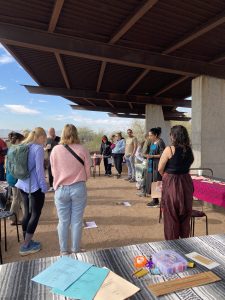
Marysol Ortega Pallanez pictured hosting a workshop where history, ecology, and personal stories come together through creative making. Photo courtesy of Prickly Design Commons.
The initiative is run by its two co-founders, Ortega Pallanez and Andrew Whitcomb, both of whom are assistant professors at The Design School at Arizona State University. Prickly Design Commons aims to build community and awareness through a variety of activities: it recently held a workshop that used archival photography to explore the history of south Phoenix’s racial inequalities, from redlining to access to green space and amenities. “We discussed how that is a reflection of racialized geographies, and how to talk with policymakers about that, using a vocabulary that we can both understand,” Ortega Pallanez says. The team has also created a series of bilingual comic books, focused on promoting reflection about people’s relationship to soil, water, and desert plants, and has more events planned to connect students with policymakers for an intergenerational dialogue on the socio-environmental issues facing their region.
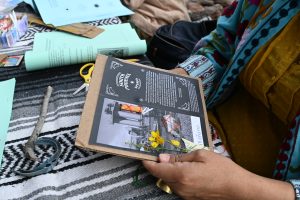
A community member transforms memories and observations from a group walk into embroidered tarot/oracle cards inspired by South Phoenix’s history of industrialization. Photo courtesy of Prickly Design Commons.